

The History of the National Park Service: Enjoying the Horace M. Albright Visitor Center and Museum of the National Park Ranger at Yellowstone National Park
Every national park visit has a starting point, and for us, that almost always includes a trip to the visitor center.
Beyond purchasing the traditional park merch and patch to add to my truck liner collection, I love the opportunity to load up on the history and details packed into the center’s museum exhibits, and for our recent visit to Yellowstone National Park, it laid the foundation not only for over a century of history for the place we were about to explore for the next two and a half days.
Established on March 1, 1872, by President Ulysses S. Grant, Yellowstone was the first national park in the world, and as a result, the Horace M. Albright Visitor Center had more to share about the park’s history than geological features. In fact, in addition to learning about the geological features and wildlife found within the park, it was here that we learned about the history of the National Park Service and the first park rangers.
Discovering the History of the National Park Service
Our first official stop once we entered Yellowstone was the Horace M. Albright Visitor Center before continuing on to explore what the park had to offer. As the world’s first national park, Yellowstone has no shortage of historical significance and it was here that we learned about the early defense of the land and the origins of the National Park Service rangers.
Prior to the establishment of the National Park Service in 1916, when Yellowstone was first created, there was no organization to officially manage it, or even a budget to protect it, this left the land and its resources vulnerable and left an unregulated temptation for people to attempt to exploit it. As a result, the U.S. Army Cavalry managed and protected Yellowstone from 1886 to 1918, defending it against poachers, vandals, and developers all vying for resources and land.
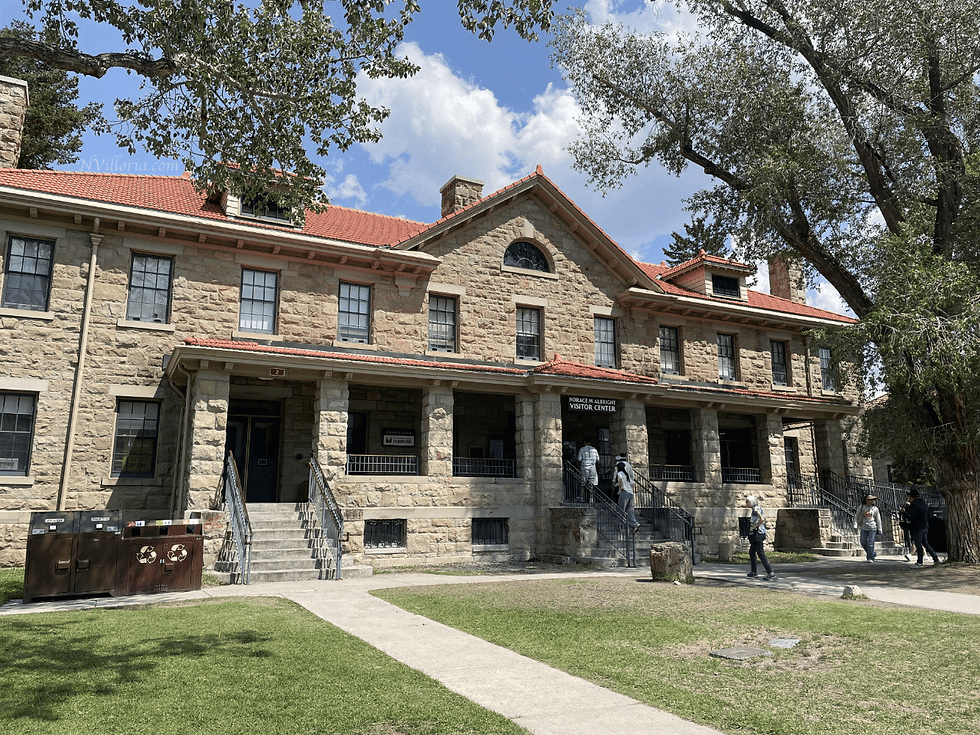
What is now the very visitor center we were walking around was originally built in 1909 and served as the Bachelor Officer’s Quarters. This building served as the anchor to the surrounding red-roofed stone buildings that made up Fort Yellowstone. This site served as the military headquarters where troops managed the park’s land, policed thermal areas, provided medical care, managed wildlife, fought fires and welcomed and educated visitors traveling in on horse-drawn carriages. During this time, Army captains served as acting superintendents, establishing standard patrol routines and military discipline that ultimately inspired the iconic uniform and protective mission of modern park rangers. This military assignment lasted 32 years in Yellowstone and paved the way for the agency we now know as the National Park Service, which was established on August 25, 1916 when President Woodrow Wilson signed the Organic Act to preserve and protect the public lands for future generations.
Some additional trivia we learned is that the Horace M. Albright visitor center is named after Horace M. Albright, who served as Yellowstone’s second superintendent and went on to become the second director of the National Park Service, working alongside the inaugural director Stephen Mather, the same Stephen Mather that Mather’s Campground in Grand Canyon National Park is named after.
Standing in the visitor center and taking in that history made me feel an overwhelming sense of pride and gratitude, and seeing how fiercely people fought to protect these lands over a century ago felt deeply empowering.
The Impactful Work of the National Park Service Rangers
Later that morning, we’d chase down the next chapter of ranger history at the Museum of the National Park Ranger positioned in one of the log cabin structures built in 1908 in the Norris Soldier Station, and a former outpost for the U.S Army Calvery. It was these outposts that served as patrol stations for troops on horseback in the summer and navigating the snowy backcountry on skis during the winter. To preserve the historical integrity of the building, the building was completely disassembled on site and meticulously rebuilt using original materials where possible and strictly adhering to its original floor plan and officially opened as the current ranger museum in 1991.

Through we’d manage to pull into the parking lot with a whole six minutes to spare before closing time and speed-walk through the historic timber cabin, furiously snapping photos of the ranger exhibits so we could actually read the history later on, which dove into more detail about what I want to be when I grow up...a.k.a. the National Park Service rangers, their work and their mission.
It was later on while reading through the photos captured at the museum that I further learned of the work that troops based at Fort Yellowstone took part of.
Duties of the U.S. Army Cavalry
Anti-Poaching & Vandalism Patrols: Soldiers navigated the backcountry and actively fought off organized poachers and stopped tourists from chipping souvenirs off geysers or throwing trash into the springs.
Infrastructure Construction: Troops provided the labor required to build and maintain the park's early wagon roads, backcountry outposts and the permanent stone structures of Fort Yellowstone.
Military Policing: Military discipline was put to use as soldiers managed stagecoach traffic, policed camps, and escorted rule-breakers out of the park under armed guard.
Survival-Focused Land Management: Resource protection was rudimentary and focused heavily on manually suppressing wildfires, protecting the ecosystems from external impact, and physically guarding the park's remaining bison herd from extinction.
Today’s National Park Rangers & Roles
Protection & Emergency Services: Law enforcement rangers patrol parks and handle criminal activity, enforce rules and issue citations. These rangers also often times double as first responders and firefighters and aid with complex technical search and rescue operations.
Interpretation & Education Rangers: Interpretive rangers are dedicated entirely to public engagement, designing museum exhibits and manage visitor centers, leading educational programs and tours, and translating complex geology and history for visitors to understand.
Scientific Resource Management: Biologists, geologists and environmental scientists are rangers that monitor geothermal health, test air and water quality, study wildlife, protect ecosystems, and execute long-term conservation strategies.
Specialized Maintenance Rangers: Dedicated trail crews repair hundreds of miles of trails, preserve historic cabins, maintain campgrounds and service public restrooms.
Backcountry & Climbing Rangers: Specializing in remote locations, backcountry rangers guide and maintain difficult terrain, check permits, and lead wilderness safety and critical search and rescue.
Over the years, the transition from the U.S. Army Cavalry to the modern National Park Service shifted Yellowstone's management from strict military defense to specialized environmental stewardship.
From reading about the progression of ranger duties and tasks, to learning about the evolution of the iconic uniform, together, the Horace M. Albright Visitor Center and the Museum of the National Park Ranger stand as a testament to the early generations who protected Yellowstone’s natural wonders. The museums’ resounding purpose is echoed throughout their displays and the park’s history; that it is imperative that these public lands, their natural resources and geological features, and the wildlife that call them home be protected and preserved.


Comments