

Old Faithful Was More Than Just a Stop: Enjoying a Hike Along the Geyser Loop Trail
Arriving at Yellowstone National Park for the first time, there was only one concern looming in the backyard of our minds…the possibility for bear encounters. Leading up to our visit we had already heard of a number of recent encounters and attacks. Because this was our first trip to the area, we were content to play it safe and stick to the main trails and scenic pullouts instead of venturing out onto too many hikes and putting ourselves in Yogi’s snack zone.
The Main Event: Seeing Old Faithful Erupt
We quickly learned that playing it safe however didn’t mean missing out, the next morning we work up early and headed to Old Faithful to experience the iconic views, and our timing couldn’t have been more perfect. We rolled into the Upper Geyser Basin early in the morning, and within thirty minutes of stepping up to the viewing area, amongst open benches positioned front and center of the geyser, and after a few false alarms of steam build up, the ground began to come alive.

For the next 2 to 3 minutes, spewing boiling water and steam put on its legendary show right in front of us, blasting thousands of gallons of boiling water over 130 feet into the air. It’s one thing to read about geothermal pressure or see photos of Old Faithful, but sitting there in person, hearing the low rumble and watching the steam drift across the horizon left me thinking how incredible it was to be able to casually watch the natural eruption take place. As I sat there taking every photo I could and saving every possible detail to memory it was mind blowing to think we were witnessing 3,700 to 8,400 gallons of boiling water release from the ground.
As the first geyser in Yellowstone to receive an official name, unlike most geysers in the park, Old Faithful’s 1.5 to 5 minute eruptions are easily predicted in intervals. This predictability is what earned the geyser its name, as the timed duration of an Old Faithful eruption can help rangers predict when the next one will occur. If an eruption is under 2.5 minutes, it means less water was expelled and the underground chamber will recharge for its next eruption in approximately 60 minutes. In contrast, a longer 4-minute eruption depletes the reservoir, pushing the next natural show to roughly 90 minutes out.

Beyond predicting its own future eruptions, the ripple effect can also help predict when similar geothermal occurrences will take place nearby due to their interconnected activity underground, sharing the same subterranean systems. So, when one geyser erupts, it can trigger or delay a neighboring vent by shifting water pressure through cracks in the rock. While rangers have dialed in schedule proximities for features like Old Faithful, Riverside and Daisy, other geysers along the basin remain completely spontaneous, blowing off steam with zero warning.
Visiting the Historic Old Faithful Inn
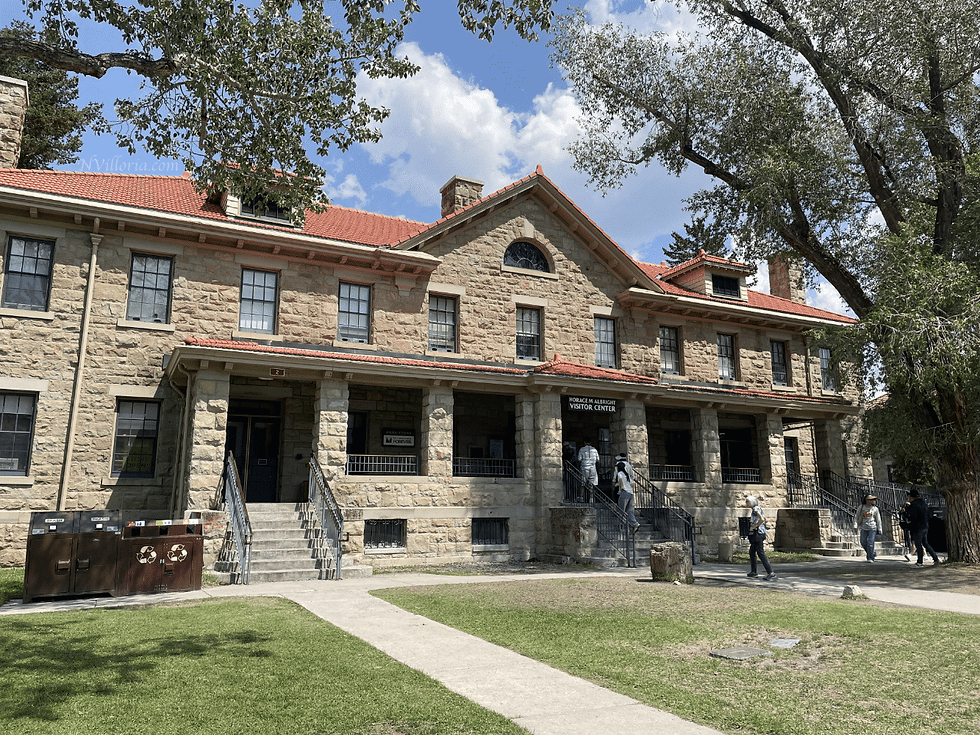
After enjoying the main attraction and our main goal for the day, we spent some time taking in the surrounding historic architecture. The Old Faithful Visitor Education Center, whose floor-to-ceiling windows perfectly frame the geyser from the inside, offers an arena-like view of the eruption. Meanwhile, just a short walk away, the historic Old Faithful Inn completely took my breath away. The sprawling, rustic timber lobby with its towering multi-story stone fireplace felt like stepping back in time and into the forest, which, it turns out, was the exact purpose of its design.
Overhearing a guide giving a tour inside the Inn, I learned that this lodge, was built to embody the feeling of being enveloped by the surrounding forest, with no two beams or window placements being alike, so as to resemble the forest canopy and the unpredictable light beams the make their way through the trees. The architect wanted to embrace the feeling of the forest so much that at its initial conception each piece of timber was still covered in bark. However, after enough complaints from housekeeping who was tired of the constant clean up of crumbling bark, the bark was eventually removed and the logs were smoothed out to resemble its current state.

Between the beams, the lighting, the pendulum clock and the towering three chimney fireplace in the center of the room this is truly a breathtaking work of architectural art that I hope to someday have the opportunity to stay at and experience at all hours. Still in awe of the building, we did take the opportunity to enjoy a nice variety of breakfast options at the breakfast buffet inside the Old Faithful Inn Dining Room, after which, we headed out to walk the Geyser Loop Trail to see what else the area had to offer.
Hiking Beyond the Crowds to Enjoy the Geyser Loop Trail
Arriving at one of the first geysers along the trail, Castle Geyser, a ranger-managed sign strategically place in front of it along the pathway, crowds gathered around one ranger erasing an old chalk-written time frame and preparing to write the next eruption prediction for the geyser. We waited with anticipation to see what the time frame would be and were brought out of our trance when the ranger laughed and teased that we were all so enthralled with what he had to write that he could write anything in that moment. He could feel the power that his chalk yielding hand held and the humor in the reality that, yes…he could write any timeframe and we’d all eat it up. The timeframe he ultimately shared was that the next eruption for that specific geyser would be anywhere between 9:45am and 12:15pm, so we decided to carry on along the route and see whatever was in store.
In total, we spent about 2.5 hours covering 5 miles of trail. The path transitioned seamlessly from paved walkways to elevated boardwalks, eventually leading us to a quiet dirt path winding through the trees as we transitioned from the Upper Geyser Basin toward the Biscuit Basin Trail. It was here that the atmosphere shifted. Far fewer crowds, less noise and feeling fully emerged in the landscape, and I was truly captivated by the wild nature of it all, even if we were still in the near vicinity of roads and other sightseers. This more isolated area was also where our internal radar was dialed up a bit as the realization that we were further into bear territory came back to the front of our mind. As a result, our conversations dialed up between us as we walked and we strategically took in our surroundings between the nearby trees, listing for anything that wasn’t the sound of a geyser or steam vent.

The entirety of the trail is a striking juxtaposition. Dense green forests line the backdrop in every direction and in direct contrast, the foreground offers an expanse of desolate white thermal rock, hardened and scorched by underground activity and broken up only by occasional thinning grass, bubbling pools or flowing runoff channels.
The diversity among the geyser features was endless. While some looked like inviting, natural bubbling hot tubs, like Spiteful Geyser, others, such as the Sentinel Geyser, shot out boiling bursts of water. Regardless of the geyser characteristics, many sat perfectly to flow directly into the Firehole River. No two thermal features were alike, and each one was just as incredible to see as the last.

Pools like Shield Spring and Spa Geyser reflected crystal clear with vibrant hues of blue surrounded by a rocky pool deck and boiling ripples breaking the surface from the heat below. A human spa they are not however. Though these were the most captivating to me, not every geothermal pool displays clear water or reflects stunning turquoise hues. Some appear as if they are filled with a rusted residue while others are colored in yellows, greens or even appeared brown in color, like the Chromatic Pool. Even more impressive were those that rippled in a kaleidoscope of colors like a geode with a crystal blue center and an array of colors expanding outward to darker yellows and reds. Along the trail we learned that these colors aren’t random, but rather telling of their characteristics. The clearer the water, the hotter the temperatures.
What Causes the Geyser Pool Coloring
The colors present in the geyser pools and runoff channels is created by microscopic organisms which thrive in various water temperatures and pH levels. Extreme heat kills off most microscopic life, leaving only pure, light-refracting water. As the water cools toward the edges, heat-loving bacteria and algae (thermophiles) thrive, creating brilliant rings of orange, yellow, and red.
Blue and Clear Water
exceed 199-degrees F, can provide an environment fo Archaea single-celled microorganisms
Yellow Water
163-degrees F, can provide an environment fo Cyanobacteria
Yellow-Green Water
144-degrees F, can provide an environment for Fungi
Green Water
40-degrees F, can provide an environment fo Algae
Green-Brown Water
133-degrees F, can provide an environment fo Protozoa
Dark Brown Water
122-degrees F or lower, can provide an environment fo Mosses, Crustaceans and Insects
Dark Brown-Black Water
80-degrees F or lower, can provide an environment fo trout
Walking further along the winding Firehole River was absolutely stunning. Every bit of scenery resembling a postcard broken up only by clouds of steam rising off of the surfaces of geysers, pools and vents. Looking into the crystal-clear pools, my mind kept playing tricks on me: my imagination promised a refreshing, soothing plunge, but the reality is a scalding hazardous cauldron. It was something so crazy to wrap my head around. The reminder of this realization was plastered at every opportunity along the pathway with depictions warning of the danger to leaving the pathways.
One of the largest and most impressive views along the trail was Artemisia Geyser, with its breathtaking deep blue color and crystal clear visibility into the depths of the pool. Surrounding the waters was a massive build-up of white rocky silica sinter (or geyserite), that snaked along the surface resembling the patterns of brains, and edges jutting out like frozen icicles. Even from our safe distance above the geyser on the elevated trail, the steam rising off the Artemisia instantly opened the pores and I couldn’t wrap my mind around how blistering hot the water truly was, beyond the steam the other noticeable reminder that this was anything but a hot pool of water was its sulfuric aroma.
Looking beyond the Artemisia, its surrounding white foundation spread outward until it gave way to a different nearby runoff channel where the white rock transitioned into rich rust-tinted reds and soft pinks, all set against the deep backdrop of the surrounding pine forest. The contrast was incredible.
Changes in Geyser Runoff Channels
The underground hot water in Yellowstone is packed with dissolved silica (quartz) from the volcanic rock beneath the park. When it is superheated, mineral-rich water reaches the surface and cools down, and can no longer hold the silica, causing it to separate from the water and deposit around the vents and geysers, slowly building up in irregular ripples and ridged layers into the hard, greyish-white, rock-like crust that is visible.
In contrast, the reddish-brown and pink colors seen around other geysers is caused by shifts in temperature which create a paradise for cyanobacteria. To protect themselves from the harsh mountain sun, these bacteria produce carotenoid pigments, creating a dense bacterial cover that, when combined with dissolved iron oxidizing in the air, dyes the surrounding rock hues of orange, red and pink.
Crossing over the flowing geyser streams on the trail boardwalks, even the subtle ripples and mineral textures visible through the moving water was mesmerizing. While these hydrothermal areas are dangerously hot for humans year-round, they serve as vital warming areas in the harsh winter months for many wildlife. When the heat thaws the snowpack and warms the soil, the landscape provides crucial warmth and open ground for bears, bison and elk. Seeing remnants of their dried tracks pressed directly into the thermal crust alongside the boardwalk was an incredible testament to how wildlife adapt and these thermal features serve an important role to the wild residents.
Eventually, our loop brought us back around the Upper Geyser Hill Trail. Here, the boardwalks grew noticeably busier again as we neared Old Faithful and the main Visitor Center, winding around the full perimeter of Old Faithful and its neighboring geysers to bring our 5-mile trek for the day to a full close.
As we pulled out of the area and left the rising plumes of steam in our rearview mirror, I couldn’t help but still smile at the front-row seat we had to one of the most unbelievable landscapes on Earth.

Comments